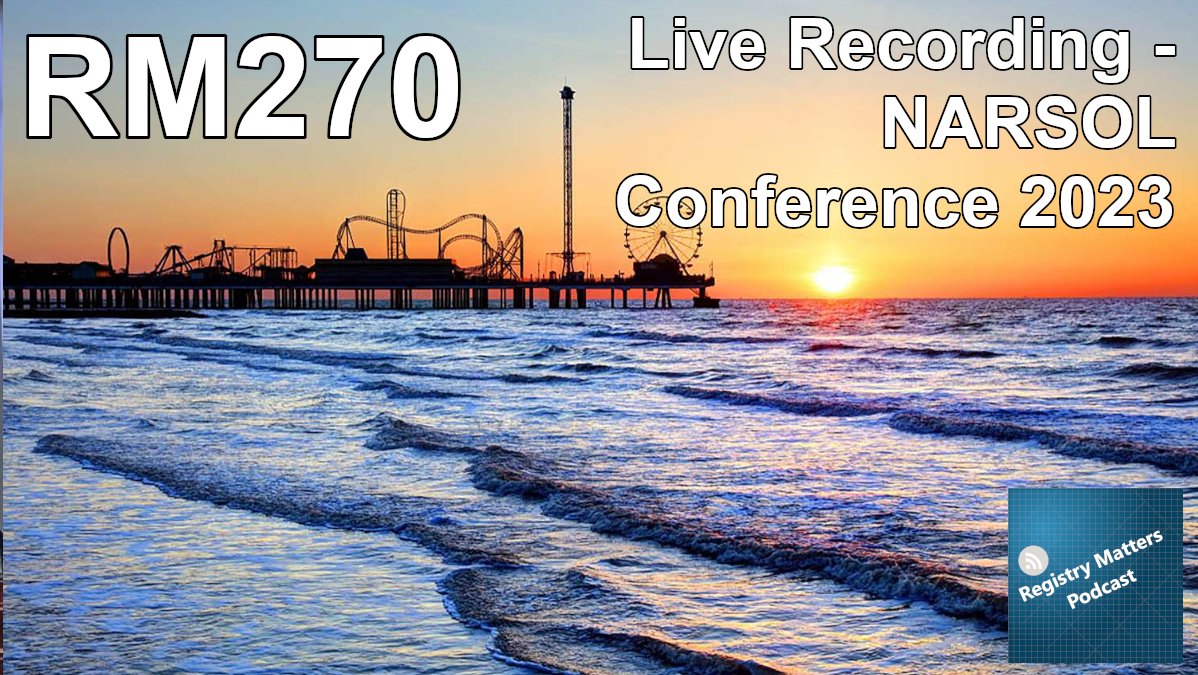
Live before a studio audience recording of the show from the annual NARSOL Conference in Houston Texas
Archives: Episode
-

RM269: How a False Food Stamps Claim Connects to Gun Rights and Registry Issues!
Andy and Larry discuss a gun case from the Third Circuit Court of Appeals that connects to registry issues. Bryan Range, who pleaded guilty to a nonviolent misdemeanor in 1995, was prohibited from possessing a firearm due to federal law. Range challenged the law’s constitutionality, claiming it violated his Second Amendment rights. The District Court initially ruled against him, but the Third Circuit affirmed the decision, stating that Range’s conviction placed him outside the class of people traditionally entitled to Second Amendment rights. The court examined factors such as the nature of the offense, the absence of violence, and the lack of imprisonment. They concluded that the government failed to justify the lifetime ban on firearm possession. The court differentiated between weapon forfeiture and a status-based ban, highlighting the lack of statutes or cases that prevent a convict from purchasing firearms after serving their sentence. Andy and Larry discuss the potential implications of this ruling for those on the registry, hoping it could challenge lifetime deprivations of constitutional rights.
[10:09] Voicemail regarding international travel
[21:13] Comment that “…but violated after transfer”
[27:24] Question regarding moving to another country
[35:22] Interstate Compact transfer
[46:16] How a False Food Stamps Claim Connects to Gun Rights and Registry Issues!
Leave voicemail: 747-227-4477
Email us: registrymatterscast@gmail.com
Support us on Patreon: https://www.patreon.com/registrymatters
Follow us on Twitter: https://twitter.com/RegistryMatters
Join the Discord server: https://discord.gg/6FnxwAQm57
Want to support Registry Matters with some swag: https://shop.spreadshirt.com/registry-matters
Apple Podcasts: https://itunes.apple.com/us/podcast/registry-matters/id1305039280
Google Play Music: https://play.google.com/music/listen?u=0#/ps/Icuxbpzvyti7wtoredipbtiojqy
RSS: https://www.registrymatters.co/feed/podcast/
Spotify: https://open.spotify.com/show/3d75P7Kc37n2l79m89F9KI
YouTube: https://www.youtube.com/registrymattersThe Registry Matters Podcast’s mission is to cover issues surrounding the Registry. We cover cases that will peel back the veneer of what we need to do to change our lives for the better. We cover news articles that spark conversations about the total insanity of this modern-day witch hunt. This podcast will call out bad policy and call out those that are making bad policy.
To change things for the positive, we need to act. We are 6-7-8-900k strong. With that many people, plus their friends and family, over a million people are affected by the registry. We should be able to secure donations to hire lawyers and lobbyists to move the agenda in our favor. We need our people to be represented.
-
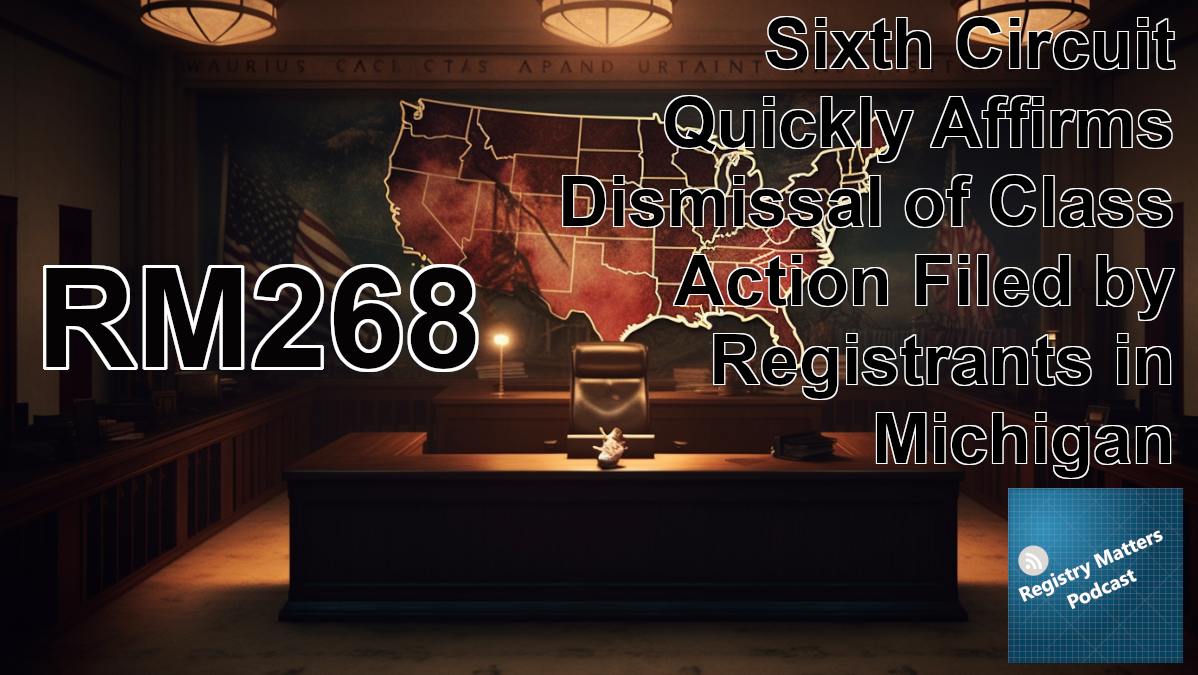
RM268: Sixth Circuit Quickly Affirms Dismissal of Class Action Filed by Registrants in Michigan
In this episode, Andy and Larry discuss a case before the Sixth Circuit Court of Appeals that has already been decided. The plaintiffs in the case sought damages from high-ranking Michigan officials, alleging that they oversaw and failed to stop unconstitutional actions by the police. The district court initially dismissed the complaint on various grounds, including sovereign immunity, and the plaintiffs appealed to the Sixth Circuit. The Sixth Circuit ultimately affirmed the district court’s decision, stating that the plaintiffs failed to state a claim of supervisory liability.
During their discussion, Andy and Larry recall their previous conversation about the case, where Larry expressed skepticism about the plaintiffs’ arguments and predicted an unfavorable outcome. They discuss the issues raised in the complaint, including due process violations, retroactive punishments, and first amendment infringement. Larry criticizes the sloppy litigation and the plaintiffs’ failure to provide sufficient evidence to support their claims. They also touch upon the issues of sovereign immunity and the plaintiffs’ attempt to hold the defendants liable based on supervisory control. The court found that the plaintiffs did not plausibly allege that the defendants authorized or knowingly acquiesced in the unconstitutional conduct, and that the allegations of knowledge were weak. The court emphasized that failure to intervene is not the same as granting authorization.
In summary, the case involved Michigan officials being sued for their alleged failure to stop unconstitutional actions by the police. The court ultimately dismissed the case, stating that the plaintiffs failed to provide enough evidence to support their claims of supervisory liability.
[2:37] Transfer of federal supervision
[14:32] Updates on Jeffrey Epstein suicide
[34:00] Sixth Circuit Quickly Affirms Dismissal of Class Action Filed by Registrants in Michigan
Leave voicemail: 747-227-4477
Email us: registrymatterscast@gmail.com
Support us on Patreon: https://www.patreon.com/registrymatters
Follow us on Twitter: https://twitter.com/RegistryMatters
Join the Discord server: https://discord.gg/6FnxwAQm57
Want to support Registry Matters with some swag: https://shop.spreadshirt.com/registry-matters
Apple Podcasts: https://itunes.apple.com/us/podcast/registry-matters/id1305039280
Google Play Music: https://play.google.com/music/listen?u=0#/ps/Icuxbpzvyti7wtoredipbtiojqy
RSS: https://www.registrymatters.co/feed/podcast/
Spotify: https://open.spotify.com/show/3d75P7Kc37n2l79m89F9KI
YouTube: https://www.youtube.com/registrymattersThe Registry Matters Podcast’s mission is to cover issues surrounding the Registry. We cover cases that will peel back the veneer of what we need to do to change our lives for the better. We cover news articles that spark conversations about the total insanity of this modern-day witch hunt. This podcast will call out bad policy and call out those that are making bad policy.
To change things for the positive, we need to act. We are 6-7-8-900k strong. With that many people, plus their friends and family, over a million people are affected by the registry. We should be able to secure donations to hire lawyers and lobbyists to move the agenda in our favor. We need our people to be represented.
-
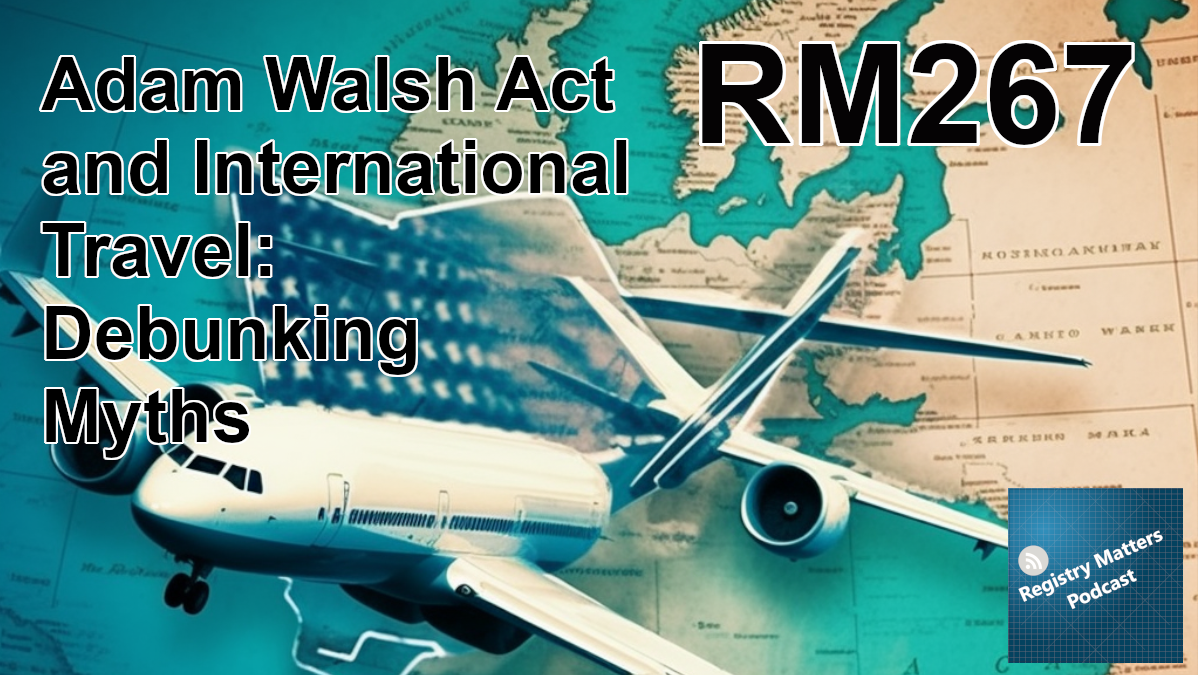
RM267: Adam Walsh Act and International Travel: Debunking Myths
In this episode, we delve into the complex intersection of sex offender registration laws and international travel. Our guest, Larry, seeks advice on his ability to travel internationally as a pilot without providing advance notice to sex offender registration authorities. The initial response suggests that there are no legal barriers to such travel, as the International Megan’s Law does not prohibit it.
However, discussions heat up when the attorney’s opinion comes into play. The attorney argues that Neil, as a Tier I offender, must comply with SORNA’s international travel requirements for 10 years, starting from his probation period. Larry, on the other hand, contests this viewpoint, stating that state laws hold authority over the duration of registration if Neil has connections or residency in Texas.
Further complications arise when the question of Adam Walsh Act requirements and international travel notice is raised. The attorney claims that once the federal duty to register expires, the obligation to provide travel notice also ceases. Larry, however, disagrees, highlighting the absence of a federal registry and asserting that state laws establish the rules. He argues that if a state like Florida requires lifelong registration and advance notice of international travel, federal law should not supersede those state requirements.
Join us as we navigate the intricate landscape of sex offender registration and international travel. We explore the implications of federal and state laws, analyze the attorney’s interpretation, and delve into the complexities of harmonizing these regulations. Listen in to gain a deeper understanding of the legal considerations surrounding sex offender registration and traveling abroad.
[2:28] Convicted in Michigan, PFR faces lifetime registration in Alabama.
[10:20] Listener Feedback Response
[37:02] AWA with Guest Neil from Texas
https://www.registrymatters.co/podcast/rm267-adam-walsh-act-and-international-travel-debunking-myths
Leave voicemail: 747-227-4477
Email us: registrymatterscast@gmail.com
Support us on Patreon: https://www.patreon.com/registrymatters
Follow us on Twitter: https://twitter.com/RegistryMatters
Join the Discord server: https://discord.gg/6FnxwAQm57
Want to support Registry Matters with some swag: https://shop.spreadshirt.com/registry-matters
Apple Podcasts: https://itunes.apple.com/us/podcast/registry-matters/id1305039280
Google Play Music: https://play.google.com/music/listen?u=0#/ps/Icuxbpzvyti7wtoredipbtiojqy
RSS: https://www.registrymatters.co/feed/podcast/
Spotify: https://open.spotify.com/show/3d75P7Kc37n2l79m89F9KI
YouTube: https://www.youtube.com/registrymattersThe Registry Matters Podcast’s mission is to cover issues surrounding the Registry. We cover cases that will peel back the veneer of what we need to do to change our lives for the better. We cover news articles that spark conversations about the total insanity of this modern-day witch hunt. This podcast will call out bad policy and call out those that are making bad policy.
To change things for the positive, we need to act. We are 6-7-8-900k strong. With that many people, plus their friends and family, over a million people are affected by the registry. We should be able to secure donations to hire lawyers and lobbyists to move the agenda in our favor. We need our people to be represented.
-
RM266: The Albuquerque Police Officer Sex Case: A Case Study in Negotiated Pleas
Learn about negotiated plea deals and defense strategies in high-profile cases from this podcast discussion. The hosts explore the case of former police officer Joshua D., accused of child solicitation and contributing to the delinquency of a minor, and discuss the challenges of negotiating a plea deal in a high-profile case. They also share strategies for defense, including finding weaknesses in the prosecution’s case, humanizing the defendant, and preparing for sentencing. Join Andy and Larry as they delve into the nuances of criminal defense in complex cases.
[6:01] Can you rent to multiple PFRs? Is it something you should fight to have changed if you can’t?
[10:02] Should non-contact, image offenses get such a large amount of prison time? And should it be considered violent?
[19:27] The Albuquerque Police Officer Sex Case
https://www.abqjournal.com/2596702/former-albuquerque-police-officer-joshua-deleon-charged-after-allegedly-trying-to-coerce-teen-into-relationship.html[49:06] End the Trial Penalty
https://www.nacdl.org/newsrelease/News-Release-~-05-03-2023?_zs=B2BgM1&_zl=uRG77
https://www.reuters.com/legal/us-criminal-justice-alliance-seeks-erase-trial-penalty-2023-05-03/
https://www.npr.org/2023/05/03/1172807956/trial-penalty-plea-dealLeave voicemail: 747-227-4477
Email us: registrymatterscast@gmail.com
Support us on Patreon: https://www.patreon.com/registrymatters
Follow us on Twitter: https://twitter.com/RegistryMatters
Join the Discord server: https://discord.gg/6FnxwAQm57
Want to support Registry Matters with some swag: https://shop.spreadshirt.com/registry-matters
Apple Podcasts: https://itunes.apple.com/us/podcast/registry-matters/id1305039280
Google Play Music: https://play.google.com/music/listen?u=0#/ps/Icuxbpzvyti7wtoredipbtiojqy
RSS: https://www.registrymatters.co/feed/podcast/
Spotify: https://open.spotify.com/show/3d75P7Kc37n2l79m89F9KI
YouTube: https://www.youtube.com/registrymattersThe Registry Matters Podcast’s mission is to cover issues surrounding the Registry. We cover cases that will peel back the veneer of what we need to do to change our lives for the better. We cover news articles that spark conversations about the total insanity of this modern-day witch hunt. This podcast will call out bad policy and call out those that are making bad policy.
To change things for the positive, we need to act. We are 6-7-8-900k strong. With that many people, plus their friends and family, over a million people are affected by the registry. We should be able to secure donations to hire lawyers and lobbyists to move the agenda in our favor. We need our people to be represented.
-
RM265: Demystifying the Interstate Compact for Adult Offender Supervision
The conversation is about the Interstate Compact for Adult Offender Supervision and how it can be confusing. The issue was raised by a question in the Legal Corner about a person who was transferred from Arizona to New Mexico and did not receive a review hearing after five years of supervision, as mandated by New Mexico law. The person in question was convicted in Arizona and has lifetime supervision imposed by Maricopa County. It is clarified that only Arizona can reduce or eliminate the remainder of the lifetime supervision, and New Mexico cannot ignore their own laws regarding review hearings for PFRs. However, the receiving state can impose special conditions that the offender must abide by. The conversation highlights the complexity of interstate supervision and the need for a better understanding of the powers each state has over offenders transferred through the ICAOS.
[3:44] Path to voting continues to be murky for Florida’s previously incarcerated
[12:00] Michigan PFR’s Seek individual liability for enforcement of vacated rules
[34:44] Transferring supervision to another state
Leave voicemail: 747-227-4477
Email us: registrymatterscast@gmail.com
Support us on Patreon: https://www.patreon.com/registrymatters
Follow us on Twitter: https://twitter.com/RegistryMatters
Join the Discord server: https://discord.gg/6FnxwAQm57
Want to support Registry Matters with some swag: https://shop.spreadshirt.com/registry-matters
Apple Podcasts: https://itunes.apple.com/us/podcast/registry-matters/id1305039280
Google Play Music: https://play.google.com/music/listen?u=0#/ps/Icuxbpzvyti7wtoredipbtiojqy
RSS: https://www.registrymatters.co/feed/podcast/
Spotify: https://open.spotify.com/show/3d75P7Kc37n2l79m89F9KI
YouTube: https://www.youtube.com/registrymattersThe Registry Matters Podcast’s mission is to cover issues surrounding the Registry. We cover cases that will peel back the veneer of what we need to do to change our lives for the better. We cover news articles that spark conversations about the total insanity of this modern day witch hunt. This podcast will call out bad policy and call out those that are making bad policy.
To change things for the positive, we need to act. We are 6-7-8-900k strong. With that many people, plus their friends and family, over a million people are affected by the registry. We should be able to secure donations to hire lawyers and lobbyists to move the agenda in our favor. We need our people to be represented.
-
RM264: Wyoming Supreme Court Rules Against DCI in Sex Offender Registration Case
On Registry Matters 264, we dive into a case where the Wyoming Supreme Court has ruled that the Wyoming Division of Criminal Investigation (DCI) overstepped its authority by requiring a Casper man to register as a sex offender 20 years after he was convicted of a misdemeanor sexual battery charge in Georgia. The court found that the DCI did not have sufficient evidence to support its decision, and that the man’s registration was therefore unlawful.
[3:01] Why does the PFR community continue to use recidivism instead of disabilities and restraints?
[8:45] Florida Senate Bill 1252 Amendments
[35:10] James Bullard, Minter versus the state of Wyoming
Leave voicemail: 747-227-4477
Email us: registrymatterscast@gmail.com
Support us on Patreon: https://www.patreon.com/registrymatters
Follow us on Twitter: https://twitter.com/RegistryMatters
Join the Discord server: https://discord.gg/6FnxwAQm57
Want to support Registry Matters with some swag: https://shop.spreadshirt.com/registry-matters
Apple Podcasts: https://itunes.apple.com/us/podcast/registry-matters/id1305039280
Google Play Music: https://play.google.com/music/listen?u=0#/ps/Icuxbpzvyti7wtoredipbtiojqy
RSS: https://www.registrymatters.co/feed/podcast/
Spotify: https://open.spotify.com/show/3d75P7Kc37n2l79m89F9KI
YouTube: https://www.youtube.com/registrymatters
The Registry Matters Podcast’s mission is to cover issues surrounding the Registry. We cover cases that will peel back the veneer of what we need to do to change our lives for the better. We cover news articles that spark conversations about the total insanity of this modern day witch hunt. This podcast will call out bad policy and call out those that are making bad policy.
To change things for the positive, we need to act. We are 6-7-8-900k strong. With that many people, plus their friends and family, over a million people are affected by the registry. We should be able to secure donations to hire lawyers and lobbyists to move the agenda in our favor. We need our people to be represented.
-
RM263: Cruel and Unusual Punishment Is not Punishment
Most people who have to register for a sexual offense think the registry seems like punishment. But is it “cruel and unusual” punishment? Making it difficult for individuals to find places they can live seems cruel. Some of the restraints placed upon registrants seem cruel as well.
And it is unusual that individuals would have their address and personal information available on the internet up to 30 years after they have served time for their offense.
But “cruel and unusual” is a high bar to meet, considering that in many states the death penalty is not “cruel and unusual.”
In The Michigan Court of Appeals versus Andrew Michael Swofford, Swofford’s attorney attemtped to convince the court that lifetime registration was cruel and unusual punishment. His argument was unsuccessful.
In Michigan, SORA Tier III offenders must report any changes to their residence, employment, e-mail address, and telephone number, and must report in person four times per year to verify their residence. It is easy to see that these are disabilities and restraints that impose onerous burdens on registrants. However, those restraints do not meet the legal standard for “cruel and unusual” punishment.
This is not to say that elements of the registry are more than a “civil regulatory scheme.” However, when discussing how to bring legal challenges before a court, it is essential to understand the nuances of laws and legal decisions. Cruel and unusual is a type of punishment. But legally, it is a type of punishment that is not applicable to the restraints that individuals on the sex offender registry face.
To a Person Forced to Register, or PFR, the registry seems like punishment. But if the registry is considered a “civil regulatory scheme,” it is no more punishment than having to get a driver’s license or register a vehicle. In order for the registry to be seen as punishment, a case has to be built properly, and the language used in the courts must be precise.
We also discuss ways that a PFR can be involved in the legislative process. First, build a relationship with a legislator or staff member if that is possible. Unless a PFR had a high-profile case, there is little chance that the legislator will take the time to find out if that individual is on the registry. Secondly, there are other ways to support candidates who are sympathetic to the plight of people forced to register for a sexual offense. Literature drops, phone banks, and monetary donations are three of those.
Highlights
[03:20] Engaging with state lawmakers.
[19:35] Professional wrestling, fake news, and civil regulatory schemes
[39:20] The Michigan Court of Appeals versus Andrew Michael Swofford.
[58:50] Police and Qualified immunity legislation.
[1:03:01] Lowering the threshold for a jury to recommend the death penalty.
How to Contact and Listen to Registry Matters
https://www.registrymatters.co/podcast/rm263-cruel-and-unusual-punishment-is-not-punishment
Leave voicemail: 747-227-4477
Email us: registrymatterscast@gmail.com
Support us on Patreon: https://www.patreon.com/registrymatters
Follow us on Twitter: https://twitter.com/RegistryMatters
Join the Discord server: https://discord.gg/6FnxwAQm57
Want to support Registry Matters with some swag: https://shop.spreadshirt.com/registry-matters
Apple Podcasts: https://itunes.apple.com/us/podcast/registry-matters/id1305039280
Google Play Music: https://play.google.com/music/listen?u=0#/ps/Icuxbpzvyti7wtoredipbtiojqy
RSS: https://www.registrymatters.co/feed/podcast/
Spotify: https://open.spotify.com/show/3d75P7Kc37n2l79m89F9KI
YouTube: https://www.youtube.com/registrymatters
The Registry Matters Podcast’s mission is to cover issues surrounding the Registry. We cover cases that will peel back the veneer of what we need to do to change our lives for the better. We cover news articles that spark conversations about the total insanity of this modern day witch hunt. This podcast will call out bad policy and call out those that are making bad policy.
To change things for the positive, we need to act. We are 6-7-8-900k strong. With that many people, plus their friends and family, over a million people are affected by the registry. We should be able to secure donations to hire lawyers and lobbyists to move the agenda in our favor. We need our people to be represented.
-
RM262: Risk for Reoffense – Who Decides?
The Static-99 is the most commonly used tool for sex offender risk assessment. Although many states are moving away from using risk-based assessments to offense-based models so they can comply with the Federal Adam Walsh act, some states still use assessments like the Static-99. A case from Rhode Island centers on another risk-based assessment tool, the STABLE-2007. In the Rhode Island Supreme Court case, State vs. Cesare, the court rules that the reliance on a STABLE-2007 assessment tool was not appropriate for determining Mr. Cesare’s assigned risk-level.
Therefore, he is eligible for a new assessment under a different tool. Other non-contact offenders can use that ruling to receive a new risk assessment.
Many who are on the registry would like states to move toward a risk-based model, but states are moving away from them. One reason is that the Adam Walsh Act recommends the use of categories to place individuals in tiers. Another reason states are moving away from risk assessments is the cost. It is easier to assign tiers on the type of conviction. Risk based assessments are more expensive to perform and are more complicated.
First of all, we need to determine what the goals are at the risk assessment scheme. Because risk assessment schemes are done for several reasons, including sentencing, parole, probation, supervision management. But in terms of registration, if you want a standalone system for registration, do you want to utilize the risk assessment to determine whether the person is visible on the internet website?
Or do you want to make it determine if the person’s duration of registration could be lessened depending on the risk? Or do you want to determine if there are any additional residence restrictions or housing or employment restrictions?
There are other important questions that need to be addressed in regards to risk-based registration.
How would you want the registration scheme to be modified?
Are you suggesting that the person not be listed on the website? Or do you want to reduce the registration periods based on the outcome?
How much would it cost to create the entity that would determine the person’s risk? That entity would need some level of staffing that would include professionals to conduct the individualized evaluations. Otherwise, you are stuck with using an instrument such as a Static 99. Which is what they are doing, I think up in Oregon.
What would the process of the appeal look like the register if they disagreed? Would it be administrative? Or would it be judicial? There’s a different level of expertise and a different level of proof and expenses related to those appellate processes.
So a lot of unanswered questions.
The episode includes several listener questions, and discussions about a bill in Oklahoma, a Clayton County corrections officer arrested for having sex with an inmate, and a short discussion about a bill in Georgia that seeks to expand the amount of criminal charges that would require bail.
Highlights
[02:01] Listener question about legislative win in Washington state.
[09:01] Are pardons recognized in other states?
[12:41] Rhode Island risk assessment case.
[38:35] Clayton County corrections officer who had sex with an inmate.
[50:16] Oklahoma bill that would allow nursing homes to the juvenile sex offender registry.
[56:04] Georgia House vote on bill that increases the number of crimes that require bail to be released from jail.
How to Contact and Listen to Registry Matters
https://www.registrymatters.co/podcast/rm262-risk-for-reoffense-who-decides
Leave voicemail: 747-227-4477
Email us: registrymatterscast@gmail.com
Support us on Patreon: https://www.patreon.com/registrymatters
Follow us on Twitter: https://twitter.com/RegistryMatters
Join the Discord server: https://discord.gg/6FnxwAQm57
Want to support Registry Matters with some swag: https://shop.spreadshirt.com/registry-matters
Apple Podcasts: https://itunes.apple.com/us/podcast/registry-matters/id1305039280
Google Play Music: https://play.google.com/music/listen?u=0#/ps/Icuxbpzvyti7wtoredipbtiojqy
RSS: https://www.registrymatters.co/feed/podcast/
Spotify: https://open.spotify.com/show/3d75P7Kc37n2l79m89F9KI
YouTube: https://www.youtube.com/registrymatters
The Registry Matters Podcast’s mission is to cover issues surrounding the Registry. We cover cases that will peel back the veneer of what we need to do to change our lives for the better. We cover news articles that spark conversations about the total insanity of this modern day witch hunt. This podcast will call out bad policy and call out those that are making bad policy.
To change things for the positive, we need to act. We are 6-7-8-900k strong. With that many people, plus their friends and family, over a million people are affected by the registry. We should be able to secure donations to hire lawyers and lobbyists to move the agenda in our favor. We need our people to be represented.
-
RM261: Police Stings–Preying on Human Emotions Works
Police stings, where officers go into adult chat rooms and pretend to be an under-aged person, continue to be an important topic. A member of CAGE (Citizens Against Government Entrapment) is our guest. We cover a range of topics, including sentencing guidelines, constitutional issues, and are police stings entrapment if law enforcement is pretending to be a minor on an adult website.
Sentencing guidelines in both states and the federal system are complicated by several factors. First, the federal government takes jurisdiction in internet-based crimes, and federal punishments are often more severe than state punishments. Second, each state has its own statutes, so it is difficult to compare the harshness of sentencing.
However, the fact that in some cases a person convicted from a sting operation will serve more time than a hands-on crime does not seem fair.
And why do these stings work? Why do men continue to communicate with an individual who after a series of exchanges claims to be underage? Well, law enforcement knows how to play these men so that it becomes more difficult to say no. Ultimately, it is the responsibility of the adult to say no, but they often don’t because they have convinced themselves the person claiming to be under-aged is interested in role-playing games.
It is also frustrating that although law enforcement is creating a crime where none would have otherwise happened, claims of entrapment are very difficult to prove in the courts.
An upcoming episode will further answer the question of are police stings entrapment.
Most of episode 261 is about police stings, but we do answer several listener’s questions about plea deals, how long a person can be held without bail, and if the judicial system would collapse if no one took a plea.
Highlights
[03:40] Listener question about the length of time you can be held without a trial.
[10:59] Would the system crash if everyone refused a plea bargain?
[18:55] Question about federal statute and residency restrictions.
[26:38] Discussion about police tactics in online stings to entice men to solicit minors.
[1:05:34] Decision to explore this topic and Georgia’s legislative decisions that move the state backwards on criminal justice.
How to Contact and Listen to Registry Matters
https://www.registrymatters.co/podcast/rm261-police-stings-preying-on-human-emotions-works
Leave voicemail: 747-227-4477
Email us: registrymatterscast@gmail.com
Support us on Patreon: https://www.patreon.com/registrymatters
Follow us on Twitter: https://twitter.com/RegistryMatters
Join the Discord server: https://discord.gg/6FnxwAQm57
Want to support Registry Matters with some swag: https://shop.spreadshirt.com/registry-matters
Apple Podcasts: https://itunes.apple.com/us/podcast/registry-matters/id1305039280
Google Play Music: https://play.google.com/music/listen?u=0#/ps/Icuxbpzvyti7wtoredipbtiojqy
RSS: https://www.registrymatters.co/feed/podcast/
Spotify: https://open.spotify.com/show/3d75P7Kc37n2l79m89F9KI
YouTube: https://www.youtube.com/registrymatters
The Registry Matters Podcast’s mission is to cover issues surrounding the Registry. We cover cases that will peel back the veneer of what we need to do to change our lives for the better. We cover news articles that spark conversations about the total insanity of this modern day witch hunt. This podcast will call out bad policy and call out those that are making bad policy.
To change things for the positive, we need to act. We are 6-7-8-900k strong. With that many people, plus their friends and family, over a million people are affected by the registry. We should be able to secure donations to hire lawyers and lobbyists to move the agenda in our favor. We need our people to be represented.